| Born: | 05-01-1916 |
| Faculty: | Medical School | Medical University Vienna |
| Category: | Expelled student |
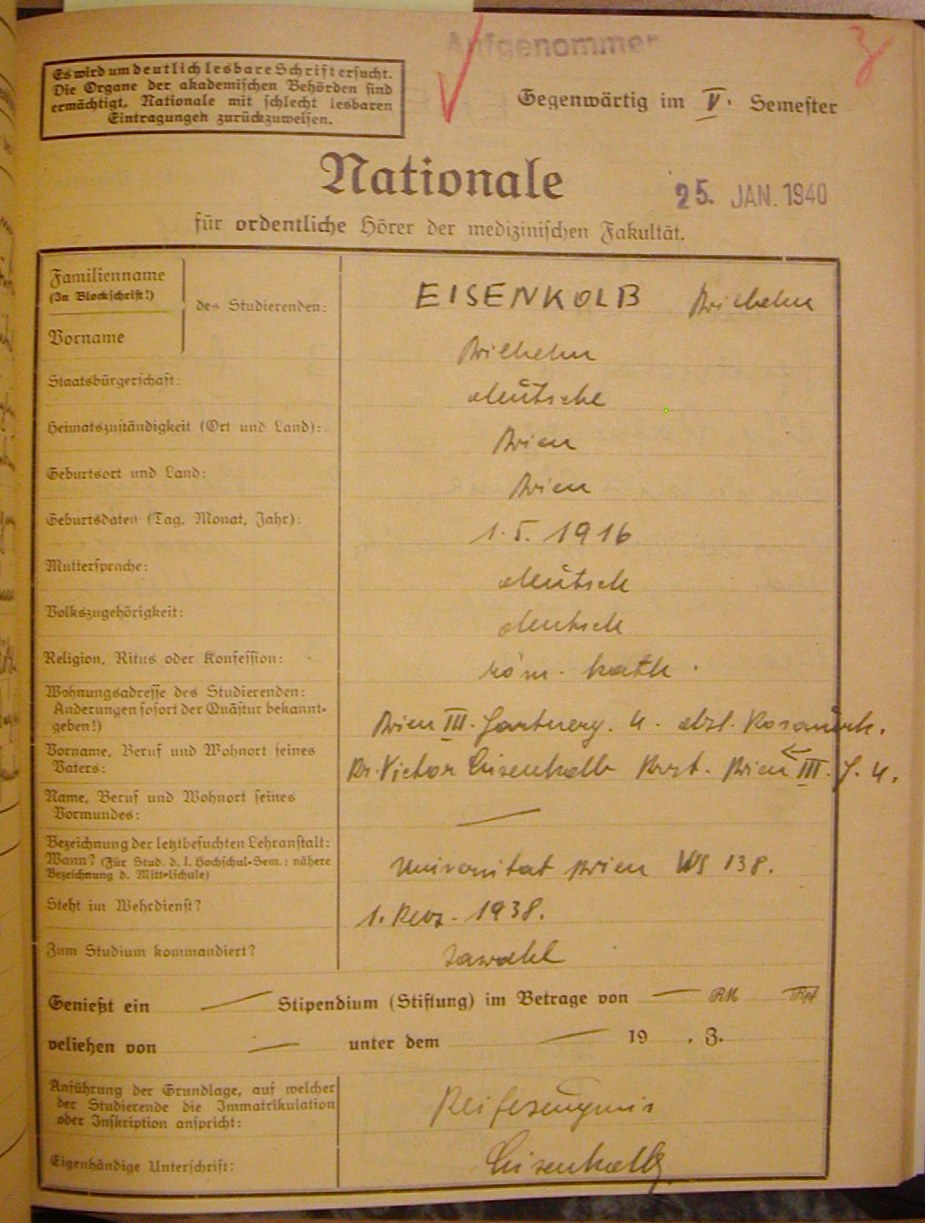
Willy (Wilhelm Viktor Ludwig) EISENKOLB, born on May 1st, 1916, in Vienna (resident of Vienna, citizenship: Austrian), son of Med.R. Dr. Victor Eisenkolb (1873-1946, public health officer for the municipality of Vienna) and Therese Eisenkolb, née Seidl (1893-?). He first lived at Gärtnergasse 4 in Vienna's 3rd district, then at Konstanziagasse 51 in Vienna's 21st district [today: Vienna's 22nd district]. Until 1932, he attended the Bundesgymnasium Wien 1., Stubenbastei, and then transferred to the German boarding school andGymnasium in Laa a.d. Thaya, Lower Austria, where he also took his school-leaving examination (Matura) in 1935. He then began studying medicine at the University of Vienna and was last enrolled in the spring term 1938 at the Medical School in the 3rd year of his studies, after passing his first rigorous examination in the fall term of 1937/38.
He was Roman Catholic, but after the Anschluss in 1938 he was persecuted on racist grounds because of his Jewish grandmother, who had died in 1903, and was classified as a "mixed race second-degree" ("Mischling"). However, he was allowed to continue his studies for the time being, subject to revocation at any time.
His older sister Maria Viktoria Eisenkolb (born 1912), who had also studied medicine, was able to obtain her doctorate in medicine without restrictions on December 20th, 1938, as no Nazi regulations for dealing with "Mischlinge" had been enacted at that time.
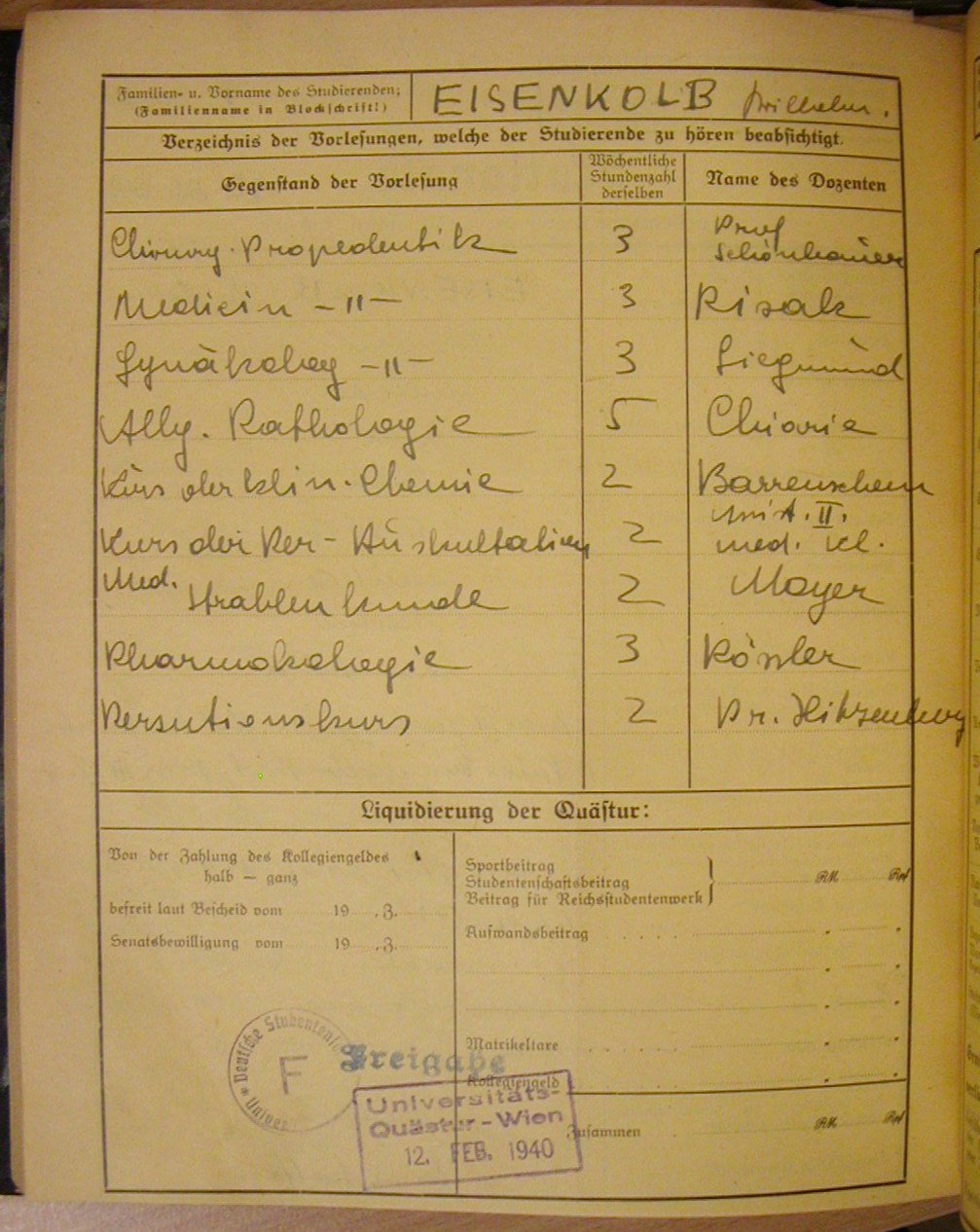
Instead, Wily Eisenkolb reported for active duty in the German Wehrmacht on December 1st, 1938, completed basic training, and took part in the invasion of Czechoslovakia in March 1939 as part of the II. Panzerdivision in Brno, was stationed in Navistova on the Polish/Slovakian border from July 1939, and was in Jablonka on September 1st during the invasion of Poland. In October 1939, as a medical student, he was transferred from the Panzer Division to San.Ers,Abt. 17 Vienna, where he completed his medical training and was then transferred to a medical company "in the field," where he was promoted to corporal and sergeant. On December 1st, he was seconded to San.Ers.Abt. 17 Vienna to continue his studies, where he was granted study leave to enroll and complete the first trimester at the University of Vienna. He then passed the medical examination in the Wehrmacht. At the beginning of April 1940, he was discharged from the Wehrmacht in accordance with an order that all medical students who had already passed their first rigorous examination would be discharged after completing one year of military service and placed on "u.k." status, which applied to him.
Shortly thereafter, he would have been dishonorably discharged from the Wehrmacht, like all "Mischlinge." In any case, despite his professed "German sentiment" and military merits, as a "Mischling" he was only allowed to continue his studies and, if at all, graduate after submitting a corresponding application for admission to the Reich Ministry of Education in Berlin, accompanied by numerous supporting documents, which he did on April 17th, 1940.
In accordance with regulations, the dean of the relevant medical faculty, Prof. Eduard Pernkopf, attached a corresponding expert opinion to the application, which, as required, "had to address in particular the personal impression of the applicant's personality and appearance. It should be mentioned whether and to what extent characteristics of the Jewish race are outwardly recognizable in the applicant.” [Decree of the Reich Ministry of Education, January 5th, 1940]. He stated: "Eisenkolb Wilhelm is a second-degree Mischling. During the illegal period, he was a member of the German Gymnastics Federation; he volunteered for military service and was present at the takeover of the Protectorate of Bohemia and Moravia; he also took part in the Polish campaign. There is nothing Jewish about his appearance."
The application was immediately forwarded to the Reich Ministry of Education in Berlin via the Medical Dean's Office and the Rector's Office, both of which endorsed it. On June 19th, 1940, the Ministry announced (WF 2541) that he would be admitted to continue his studies and take the medical examinations, "with the proviso that this does NOT entitle them to be appointed as doctors. They will be appointed as doctors provided that the subsequent findings to be made shortly before the decision on the appointment are made show that there are no objections to the political and moral reliability of the candidates and their families."
However, it seems that it did not come to that, as there is no further reference to a doctorate at the University of Vienna.
Little is known about the rest of his life, but he is believed to have been captured as a soldier at Stalingrad and to have died in a nearby prisoner-of-war camp in 1943.
After the end of World War II, he was officially declared dead by the Vienna Regional Court on January 27th, 1956, with the date of death given as "April 4th, 1943," and the place of death as "Frolovo Prisoner of War Camp."
Lit.: Archive of the University of Vienna/National MED 1937-1941, MED GZ 1115 ex 1939/40, RA GZ 944 ex 1939/40/41, MED S 51.1 ONr. 17 and MED S 51.2 ONr. 14; Doctoral thesis MED 1929-1941, No. 4279; REITER-ZATLOUKAL/SAUER 2025; www.ancestry.de.
Herbert Posch